


Send Message
Privacy statement: Your privacy is very important to Us. Our company promises not to disclose your personal information to any external company with out your explicit permission.

Foshan Nanhai Halo Sanitary Ware Co., Ltd.
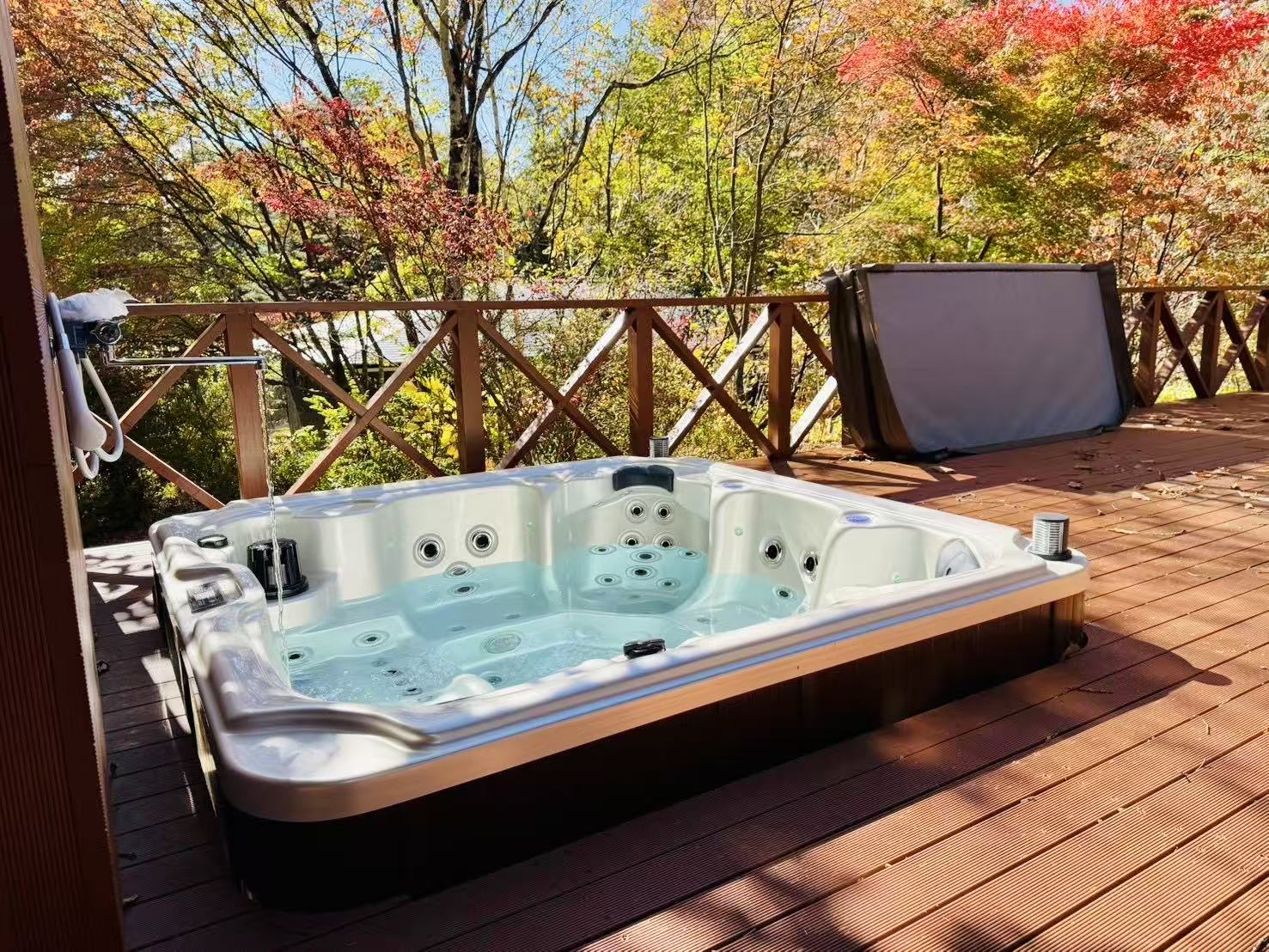
For an indoor installation, leave approximately 50–100 mm of additional space beyond the tub dimensions as a basic reference. The room should also have suitable drainage and ventilation because warm water creates humidity. The floor must support the filled tub and users, and electrical work should be completed by a qualified professional according to local requirements. Keep service panels accessible instead of placing the tub tightly against every wall.
Outdoor installations need a level, stable base that can support the filled tub. Consider sunlight, wind, rain, drainage, privacy, and the route used to move the product into position. Avoid placing the shell surface next to a heat source above 70°C (158°F). Leave enough clearance to open the cover and remove service panels. A reinforced concrete base is often considered for heavy installations, but the final base design should be checked by a qualified installer.
For an in-ground or built-in installation, Aquaspring guidance uses a reference of about 500 mm of extra space around the four sides of the pit and at least 150 mm of concrete support below the unit. These are planning references, not a substitute for a project-specific engineering review. Drainage, waterproofing, access panels, lifting access, and maintenance routes should be confirmed before construction begins.
| Planning item | What to confirm |
| Dimensions | Tub size plus clearance for the selected installation |
| Base | Level support designed for the filled unit and users |
| Access | Delivery route, cover movement, and service-panel access |
| Utilities | Electrical supply, drainage, ventilation, and water access |
| Safety | No contact with heat sources above 70°C (158°F) |
Q: Can I install a hot tub directly on any patio or deck?
A: Not automatically. The base must be checked for level, drainage, and load capacity when the tub is filled and occupied. A qualified installer should review the site before installation.
Q: Why is service clearance important?
A: Pumps, valves, electrical parts, and plumbing need to remain reachable for inspection and repair. Blocking the service panels can increase maintenance time and may require partial removal of the installation.
Q: Does an Indoor Hot Tub need ventilation?
A: Yes. Indoor warm water adds humidity to the room. Ventilation and drainage should be planned with the building professional so the room can manage moisture safely.
Aquaspring can provide product dimensions, configuration information, 3D design support, and engineering guidance for residential, commercial, and hospitality projects. Sharing the intended site conditions early helps the team review the right model, access route, base plan, and service requirements before production.

October 28, 2026
Email to this supplier
October 28, 2026
Privacy statement: Your privacy is very important to Us. Our company promises not to disclose your personal information to any external company with out your explicit permission.
Fill in more information so that we can get in touch with you faster
Privacy statement: Your privacy is very important to Us. Our company promises not to disclose your personal information to any external company with out your explicit permission.